
Scarecrows come in all shapes and sizes
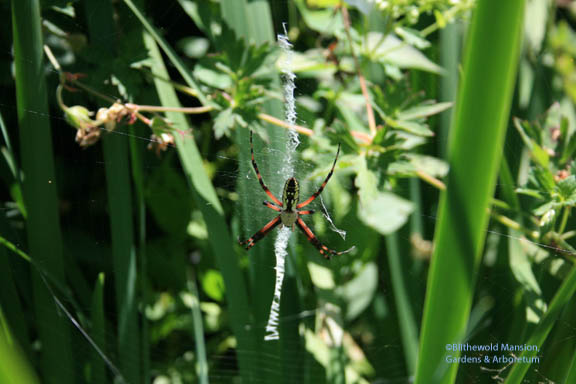
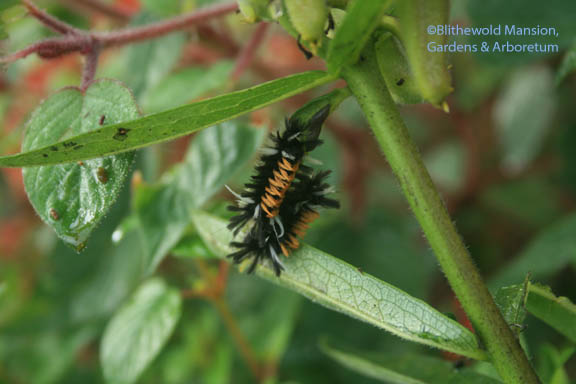 I still haven’t seen any of our super scary yellow and black orb-web spiders, but it’s been a week of other frights – which of course makes me think of Halloween even though we’re still miles away. On Tuesday the “Deadheads” discovered no fewer than a baker’s dozen candy-corn colored caterpillars on one of our butterfly weeds (Asclepias tuberosa). But these were no ordinary monarch or swallowtail – even my favorite i.d. book, Garden Insects by Whitney Cranshaw failed me on this one. Thank goodness for google. They are Milkweed tussock or tiger moth caterpillars (Euchaetes egle) and their vacuum-roller-brush lashes render them completely unappealing to most hungry birds, or so I would imagine. (This caterpillar currently tops my list for what I want to be for Halloween.)
 Cathy (Harvestmeister) discovered who was devouring the last of the cherry tomato plants. I might be blamed for helping myself to some of the tomatoes but this tomato hornworm was filling up on foliage. We let him be though because a parasitic wasp has already laid claim, so to speak. Tomato hornworms can reach up to 4″ or so in length though this one is probably only about 2″. I wonder if the tusk on their hind is a bird deterrant – though if not, I can’t imagine being covered in wasp cocoons is very appealing either. The braconid wasp, which lays its eggs on the hornworm is considered a beneficial parasitoid. Any time their eggs are observed on a hornworm, the hornworm should be left alone so that the wasp can keep doing what it does best. And when the hornworm grows up (if it’s not eaten by wasp larvae), it becomes the Sphinx moth a.k.a the hummingbird moth which has an impressive wingspan of 4-5″. It’s a bird of another feather for sure and a pollinator to boot.
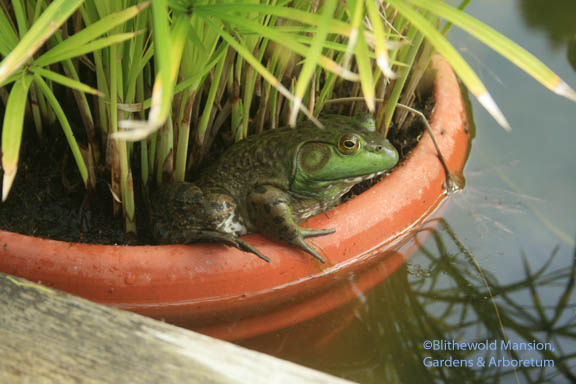
Speaking of things that are larger than life, Augustus van Wribbit is back in our cement pond and easily twice his former size. I wonder what he’s been eating… We’re so glad the Display Garden’s guard is back at his post.
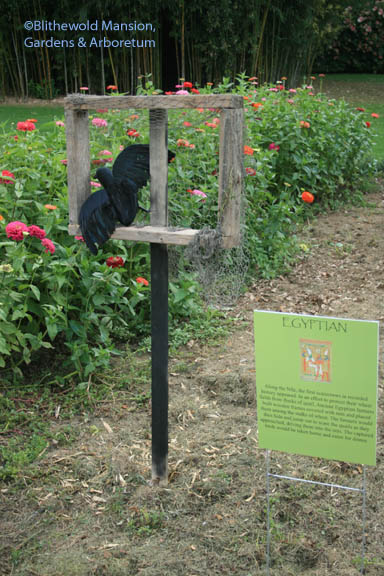 And speaking of garden guards, the “History of the Scarecrow” exhibit is being installed near our vegetable bed just in time for Blithewold’s Autumn Splendor series of events. No doubt our Brussels sprouts and spinach will be extra safe from crow predation due to the row of formidable scarecrow examples from Ancient Egypt (the very creepiest) all the way to the Wizard of Oz. These days, I kind of think our gardens might be better served by Deerbullies or Groundhoghorrifiers. Perhaps examples of those will be displayed next year…
Is there anything scary in your garden yet?