Subscribe

Calendar

May 2013
MTW TFSS
  12345
6789101112
13141516171819
20212223242526
2728293031

Weather at Blithewold

  • Weather for Bristol, RI
    Today
    It is forcast to be Rain Showers at 11:00 PM EDT on May 25, 2013
    Rain Showers
    54/41


  • Follow Me on Pinterest

  • Blithewold Mansion

    Create Your Badge


  • March blooms (in spite of itself)

    March 19th, 2013 by Kristin Green

    I was only away from Blithewold for a week (and not very far away either — on staycation at home) but it’s amazing how much happened here in that time. Spring happened. Almost. The start of it anyhow. At least inside the greenhouse. The propagation house is chock-a-block full of seed trays — it’s hard to believe we can make more room but Dick, vegetable gardener extraordinaire, was in today to sow some more. And like a clown car, we stuffed four more trays (of eggplants and peppers) on the benches. The sweet peas are all up — and uneaten by mice. Such a pretty sight! The whole greenhouse in fact, is gorgeous. The scent of the Ponderosa lemon in full bloom is enough to knock me over. And our jasmine, which is only about a third open yet, is so strong it’s almost too much. But I’ll take it, breathing deeply, especially since I’ve been away from it. I realize now that I’ve been taking the greenhouse’s early spring totally for granted and even on a raw day like today, it’s kind of heaven in there. (If you’re nearby, please visit. Especially if you’re feeling as demoralized by the weather as I am.)

    Outside, since we have another layer of slushy snow on the ground and are being pelted with freezing rain, it’s hard to believe that spring’s official start is only a day away. But there are more signs showing than there were a week ago, mostly in the bed just outside the Rose Garden’s moongate. I took these pictures yesterday… Click on any of the pictures for a bigger view or hover over for the caption.

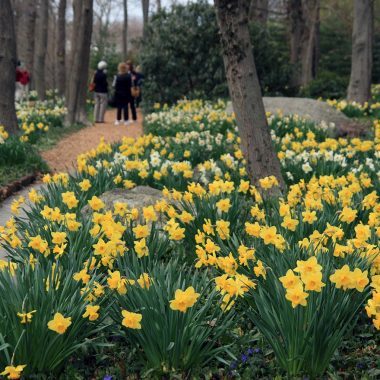
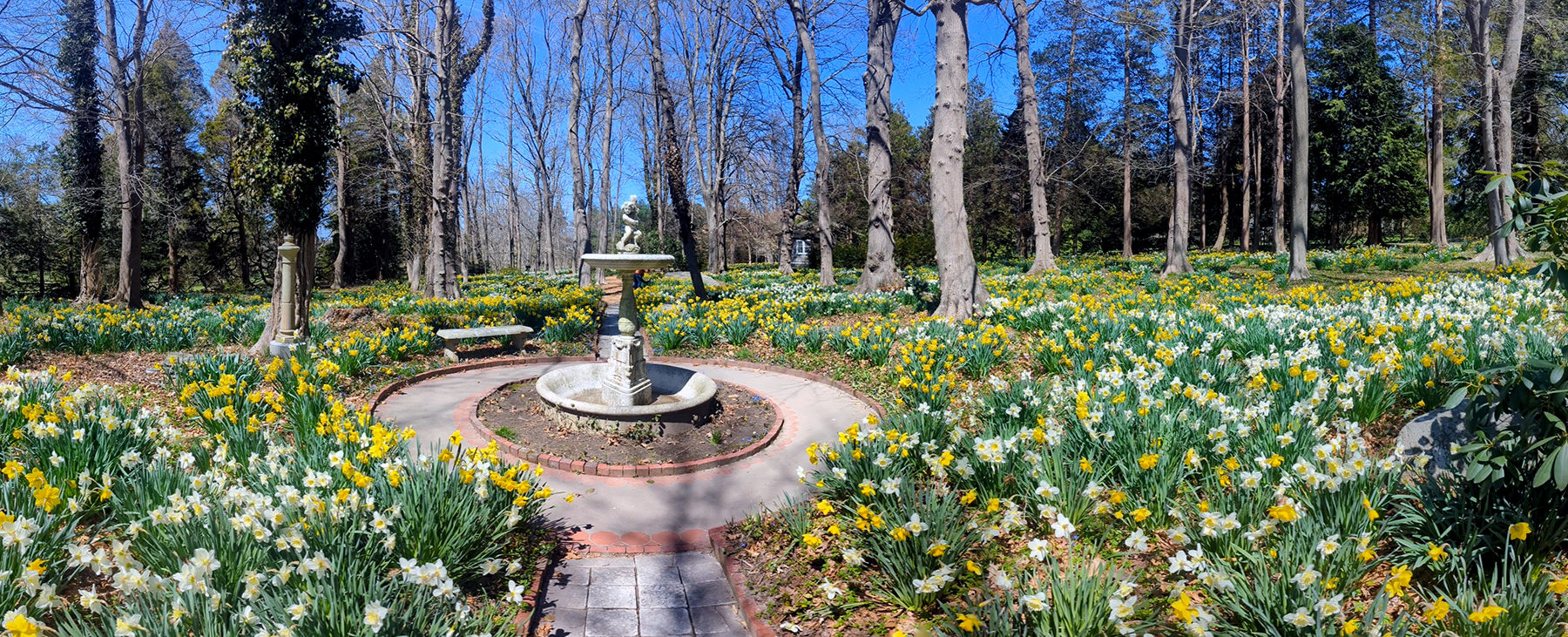
    With weather like today’s, we can be sure that spring – meaning the daffodils – won’t be extra early like they were last year. Probably right on time. We hope. (Did I hear more snow for next week? Say it isn’t so!) We’re opening for the season, snow or shine, on April 2 this year. And then Daffodils Days start up, whether still budded or blooming, on Saturday, April 6. Is March blooming in your garden? How about inside?


    Winter’s sculpture

    March 7th, 2013 by Kristin Green

    Another heavy, wet snow is coming at us sideways today. I don’t mean to whine (yes I do!) but we’ve had just about enough of that this winter. And it has taken its toll all over the property. The other day I took a walk through our bamboo grove (yellow groove – Phyllostachys aureosulcata). It usually pops back up after a snowfall. Not this year. Each snowfall landed like another ton of bricks. But I’m inclined to find the damage beautiful – like an art installation – because I know the grove will recover. The broken culms will have to be cut out, and the grove roped off while new shoots rise in May and June, but soon enough – maybe even by this summer, it will be hard to tell it was ever so smashed. (Click on pictures for a bigger view.)

    Did winter make any sculptures in your garden?

    Leap of faith

    March 5th, 2013 by Kristin Green

    Waiting for the Chiltern seed order – which included a dozen varieties of sweet peas – to arrive tested our faith (and taught me a little lesson about putting so many precious eggs in one basket). But Gail and I remained as optimistic as gardeners, and didn’t the package finally land in our mailbox like a little miracle the day after we opened up bench space! We always sow the sweet peas first, during the last week or two of February so that they’ll be sturdy enough to set outside and plant by the last week in April.

    Every year I worry all over again that the seeds I sow won’t germinate (and that’s partly why I prefer Beverly, one of the Rockettes, to do it – that, and I love her company). It just seems so unlikely that a whole blooming plant would ever spring from such a tiny package – even if it’s as fat and perfect as these sweet pea seeds – with or without help from me.

    Gail and I started some others with the reputation of taking an age to germinate and a few like corydalis and primroses that need alternating weeks in the fridge and out of it. — It’s no wonder I doubt seeds when there’s trickery involved… But unless the seeds are no longer living – some are viable for only a short time after ripening while others can remain dormant indefinitely – they’re hardwired to grow soon(ish) after we trip their trigger by tucking them into moist soil. At least that’s what I remind myself around this time every year. All will be well.

    Spring requires the same leap of faith. That buds will stretch into flowers, like the witch hazels already did, and that the birds will sing. A more confident friend reassured me this morning that I didn’t hallucinate hearing a red-winged blackbird’s call. It is, in fact, time for them to come back. Like clockwork. So despite a chill wind again from the north and snow in the forecast, spring is on its way. — Isn’t it?

    Partly springy

    February 25th, 2013 by Kristin Green

    Given that I lost patience with winter way back in December, I’m pretty excited to notice that despite weekly storms and another overnight icing of a wintery mix, spring is starting to win the tug of war. When the sun is out – and the wind isn’t blowing a gale – it’s warm enough to bask a little. Everything is dripping, the ground is squishy, and the birds are singing love songs. Looks at least partly springy out to me. I know I’m probably jumping the gun a little because March is usually disappointingly March-like but I can’t help it. I’m just so ready to see spring in the smallest signs.

    The biggest sign of spring is easy enough to see – and feel: the sun is finally high enough in the sky that the greenhouse is getting cooking. By mid-morning on a sunny day over the last couple of weeks it has become so deliciously summer-like in there we have had to strip off sweaters and scarves and squint or put on sunglasses. The plants are responding to the extra light and heat by outgrowing containers, blooming away, and becoming susceptible to infestations. – Aphids and whitefly seem to love spring as much as I do. So we and a handful of volunteers have started taking sunny opportunities to keep up with the grooming and leaf washing. (We’ll try to rotate all the garden volunteers in for a vitamin-D fix.) I have followed the sunbeams around my house to do the same thing… And today Gail and I started emptying benches to make room for more plants because we’ll start some seeds this week. If that isn’t a sure sign of spring, I don’t know what is.

    Missing February bloom day is my excuse for posting some gratuitous sunny greenhouse flowers (clockwise from top left): Everyone thinks this camellia (unnamed) is a double hibiscus – it’s that tropical looking. Amaryllis ‘Zombie’ has been on a blooming rampage since December. The blue Marguerite (Felicia amelloides ‘Variegata’) is also unstoppable, and completely unbothered by insects. And even though the Spanish shawl (Centradenia floribunda) will quit blooming by summer it’s worth every inch of its bench space for the flowers now.

    Is it partly springy in your garden yet? Are your houseplants going nuts? When will you start your first seeds?

    Bee School (part 1)

    February 19th, 2013 by Kristin Green

    The first thing I learned in bee school is that more people are interested in keeping bees than I would have thought. In the 2 classes held at RIC there are over 100 people enrolled. The second thing I learned was that beekeepers are as generous and enthusiastic as gardeners. They want anyone and everyone who is interested in keeping bees to succeed. To that end, the RI Beekeepers Association runs several bee school classes every year, holds monthly meetings, and encourages every newbie (newbee?) to ask lots of questions and shadow a mentor. And it’s a big enough network that we students have been reassured that there would always be a more experienced beekeeper nearby willing to come over to help inspect a hive and answer questions. With such a safety net, it would be very hard to fail.

    Which is a good thing because there’s a lot to it. A lot of bees for one thing – 50,000+ workers and drones (depending on the time of year), plus one queen, make up a healthy colony. The queen can lay over 1000 eggs per day that grow into new workers (and drones) to replace old — individuals (besides the queen) only live about 40 days altogether.

    The colony’s goal is to reproduce and survive the winter and it’s a fascinating community effort. The workers have specific roles that change over the course of their lifespan, going from nurse bee to house bee to guard. After about 3 weeks in the hive, they go out as the foragers we gardeners know and love. Interestingly, the workers, not the queen, make all the decisions about what the foragers should bring back to the hive (nectar, pollen, water), whether the queen is getting old and needs replacing, and when it’s time for the colony itself to reproduce (swarm). Drones only job is to fly around in great comet-shaped congregations and mate with the queen. They mooch food from the workers and are kicked out of the hive before winter.

    And there’s a lot involved in keeping a colony healthy. So much that it has made my head spin and I haven’t even learned yet about all of the problems, diseases, and infestations to which they’re so susceptible…

    In last week’s class I learned that there are no ordinances against keeping bees in Rhode Island. But keepers in the urbs and suburbs should be discreet (hide hives in the back yard and paint them to blend in) and be super sensitive to neighbors’ worries. (Giving away honey is said to help assuage fears.)  Apiaries should face south or southeast for winter sun, and be out of the way of heavy human, animal, and car traffic. And we’ve got to get it right. Once the bees are in residence, the hive can only be moved less than 3′. Or more than 3 miles. And bees will need a nearby water source to keep them out of your neighbor’s pool.

    Blithewold’s bees are situated beautifully, facing south in full winter sun. It was warm enough today that I thought I might see some activity (in the winter, bees leave the hive on sunny days for “bathroom breaks”) but I pressed my ear up to the hive body and thought I could hear them hum. I can’t wait to learn more and maybe shadow our volunteer beekeeper and have a peak inside…